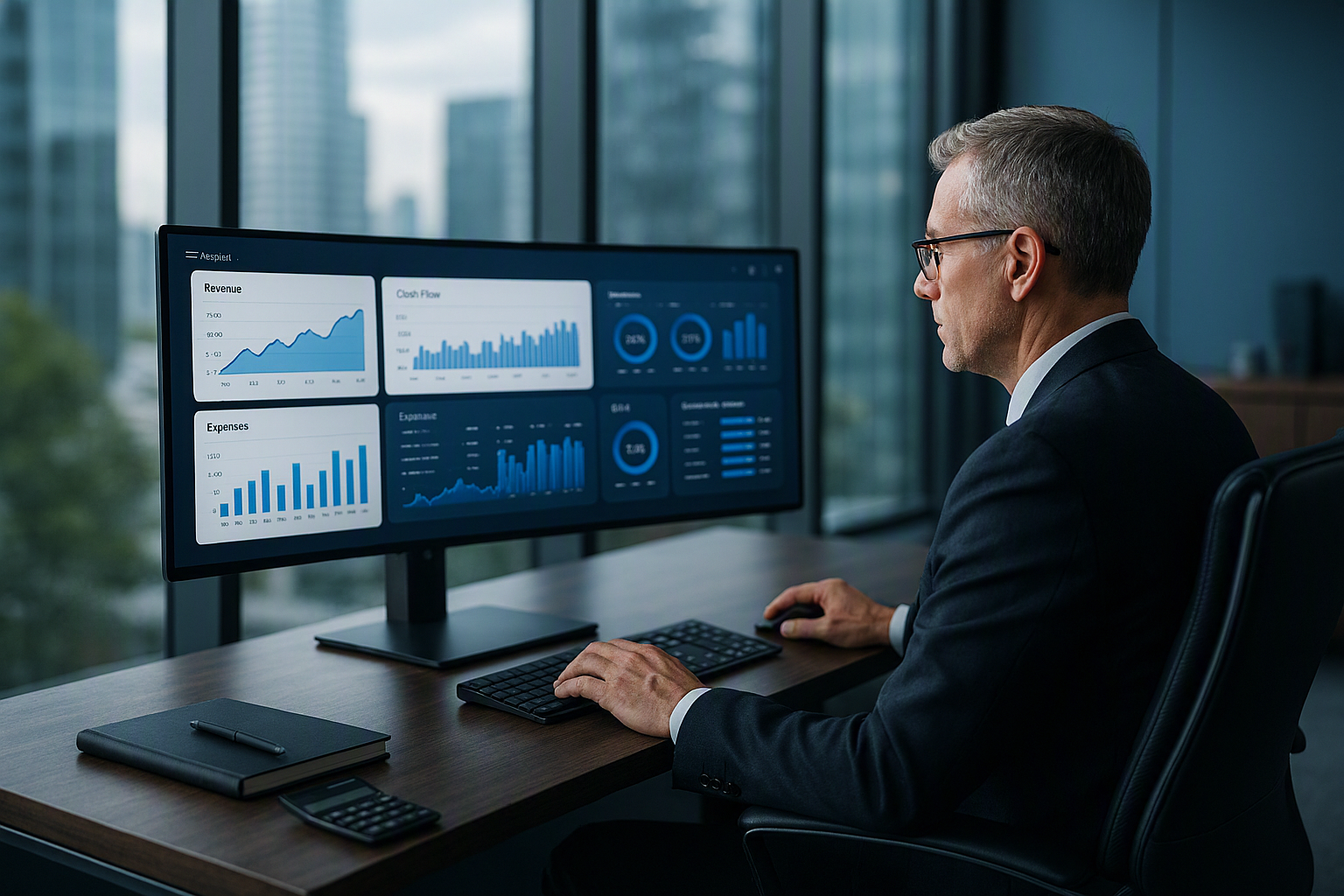
This is exactly the gap that real-time financial reporting was built to close. Instead of waiting weeks for a finance team to compile spreadsheets or reconcile accounts, businesses today expect financial data that updates as transactions happen — giving leadership the ability to act on facts instead of guesswork.
At AI Finora, we work with businesses across the USA to modernize how they track, interpret, and act on their financial data. We’ll break down exactly what real‑time financial reporting means, why it has become essential for financial reporting in the USA, and how the right combination of automation and expert guidance can transform the way your business makes decisions.
What Is Real‑Time Financial Reporting? A Complete Guide to Instant Financial Insights
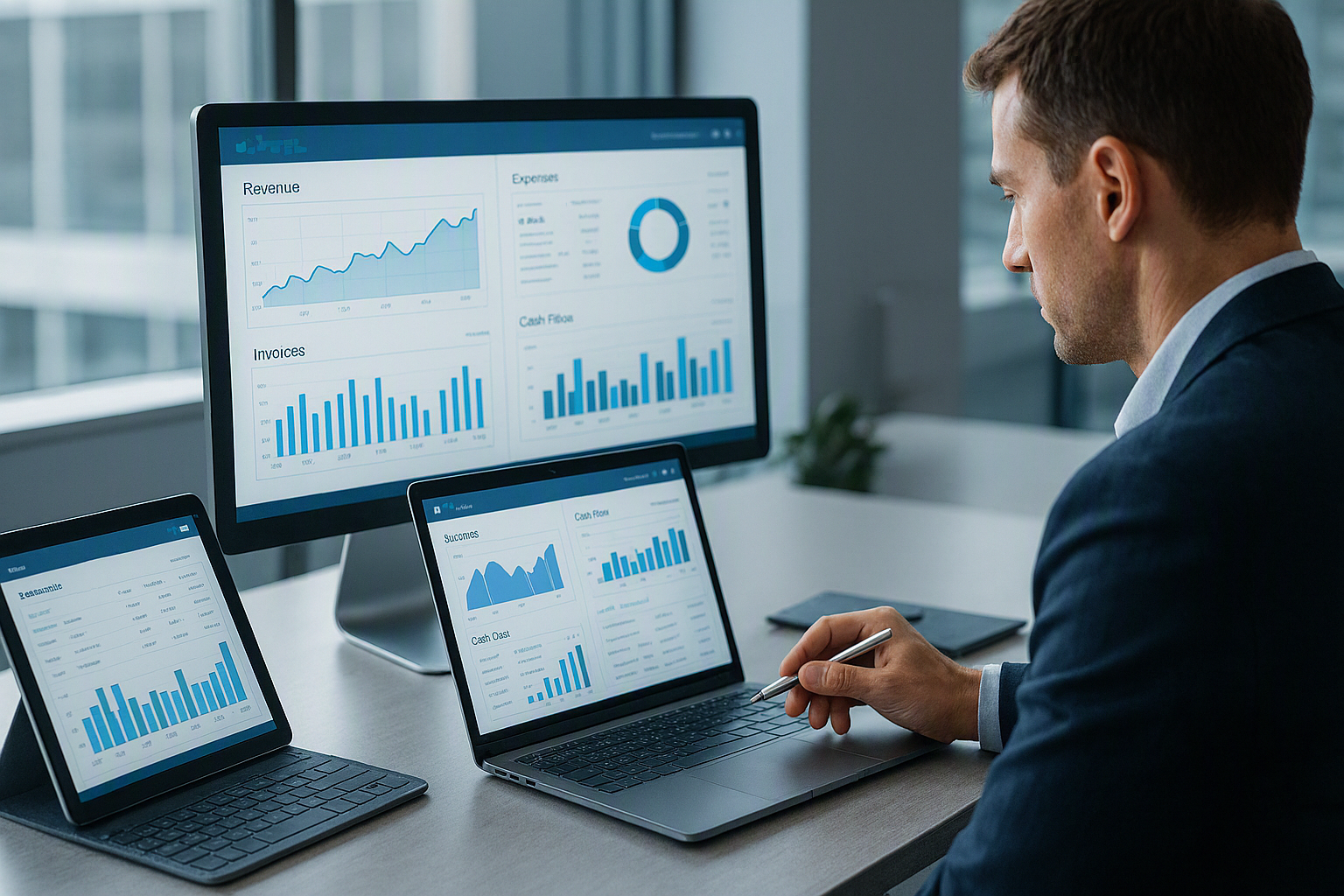
Real‑time financial reporting refers to the continuous, automated collection and presentation of financial data as transactions occur, rather than relying on periodic manual updates. In a traditional setup, a business might close its books monthly or quarterly, meaning decision‑makers are often reviewing data that is already weeks or even months old by the time it reaches their desk. Real‑time reporting eliminates that lag entirely.
Through connected accounting systems, cloud‑based platforms, and automated data pipelines, every sale, expense, invoice, and payment is reflected in dashboards and reports almost instantly. This means a business owner can log in at any point during the day and see an accurate, up‑to‑date picture of revenue, expenses, cash position, and profitability — not an estimate based on last month’s closing figures.
This shift matters because financial reporting has traditionally been treated as a backward‑looking exercise: a way to document what already happened. Real‑time reporting flips that model, turning financial reporting into a forward‑looking decision‑making tool. When numbers are current, businesses can respond to problems while they’re still small and capitalize on opportunities while they’re still available.
Understanding the Shift from Traditional to Real‑Time Financial Reporting
For decades, financial reporting followed a predictable rhythm: transactions were recorded throughout the month, accountants reconciled everything at month‑end, and reports were distributed days or weeks later. This cycle worked reasonably well in slower‑moving economic environments, but it creates serious blind spots in today’s fast‑paced business landscape.
Consider a retail business that experiences a sudden drop in a specific product category’s sales. Under a traditional reporting cycle, that decline might not be visible until the monthly report is generated — by which point the business has already lost weeks of potential corrective action. With real‑time financial reporting in the USA, that same dip would be visible within days, giving management the chance to investigate and respond immediately.
Why Financial Reporting in the USA Is Evolving Faster Than Ever
The demand for real‑time visibility isn’t just a trend — it reflects genuine structural changes in how American businesses operate. Financial reporting in the USA has had to evolve alongside several key pressures unique to the current business environment.
First, regulatory expectations have grown more complex, with businesses needing to demonstrate accurate, auditable financial records across multiple reporting frameworks. Real‑time systems make it significantly easier to maintain compliance because data is captured and categorized correctly from the moment a transaction occurs, rather than being reconstructed later.
Second, the rise of remote and distributed teams means that financial decision‑makers are rarely all in the same room, let alone the same building. Cloud‑based, real‑time reporting allows a CFO in one city, an operations manager in another, and outside financial advisors to all view the same live data simultaneously, eliminating the delays and miscommunication that come from emailing spreadsheets back and forth.
Third, competitive pressure has intensified across nearly every industry. Businesses that can identify cash flow issues, pricing inefficiencies, or unexpected cost increases in near real‑time have a meaningful advantage over competitors still working from monthly reports. This has made investment in financial reporting services in the USA a priority for businesses of every size, from small local operations to multi‑location enterprises.
Key Components of a Real‑Time Financial Reporting System
Understanding what makes up a real‑time financial reporting system helps clarify why it delivers such a significant advantage over traditional methods. While specific setups vary by business, most real‑time systems share a few core components.
Automated Data Integration
Bank accounts, payment processors, point‑of‑sale systems, and payroll platforms are connected directly to the accounting system, so transactions flow in automatically without manual entry.
Cloud‑Based Accounting Infrastructure
Rather than relying on desktop software with limited access, real‑time systems operate in the cloud, allowing authorized users to view live data from any device, at any time.
Dynamic Dashboards
Instead of static reports, real‑time systems present data through interactive dashboards that update continuously, allowing users to drill down into specific categories, time periods, or departments.
Automated Reconciliation
Transactions are matched and reconciled automatically against bank and credit card statements, reducing the errors and delays associated with manual reconciliation.
Alerts and Notifications
Many systems include automated alerts that flag unusual activity, such as a spike in expenses or a drop in incoming payments, so issues are caught immediately rather than during a periodic review.
Together, these components create a financial reporting environment that is not only faster but significantly more accurate, since much of the manual data handling — and the human error that comes with it — is removed from the process entirely.
Benefits of Real‑Time Financial Reporting for Growing Businesses
The advantages of adopting real‑time financial reporting extend across nearly every function of a business, from day‑to‑day operations to long‑term strategic planning.
Faster, More Confident Decision‑Making
When leadership has access to current data, decisions about hiring, spending, inventory, and investment can be made with far greater confidence, rather than relying on outdated figures or gut instinct.
Improved Cash Flow Management
Cash flow problems are among the leading causes of business failure, and real‑time visibility allows businesses to spot potential shortfalls weeks before they would appear in a traditional monthly report, giving ample time to adjust.
Stronger Investor and Stakeholder Confidence
Businesses seeking funding or reporting to stakeholders benefit enormously from being able to present accurate, current financial data rather than reports that are already outdated by the time they’re reviewed.
Better Budget Accuracy
Real‑time data makes it far easier to compare actual performance against budgeted figures continuously, allowing for quicker course corrections rather than discovering a significant variance at quarter‑end.
Reduced Administrative Burden
By automating data entry and reconciliation, finance teams spend less time on repetitive tasks and more time on meaningful analysis, freeing up resources that would otherwise be spent catching up on backlogged reporting.
Enhanced Compliance and Audit Readiness
Continuous, accurate record‑keeping means businesses are essentially audit‑ready at all times, rather than scrambling to reconstruct records when tax season or an audit arrives.
Real‑Time Reporting vs Traditional Reporting: What’s the Difference
While the benefits of real‑time financial reporting are clear, it’s worth directly comparing the two approaches to understand exactly what changes for a business making the switch.
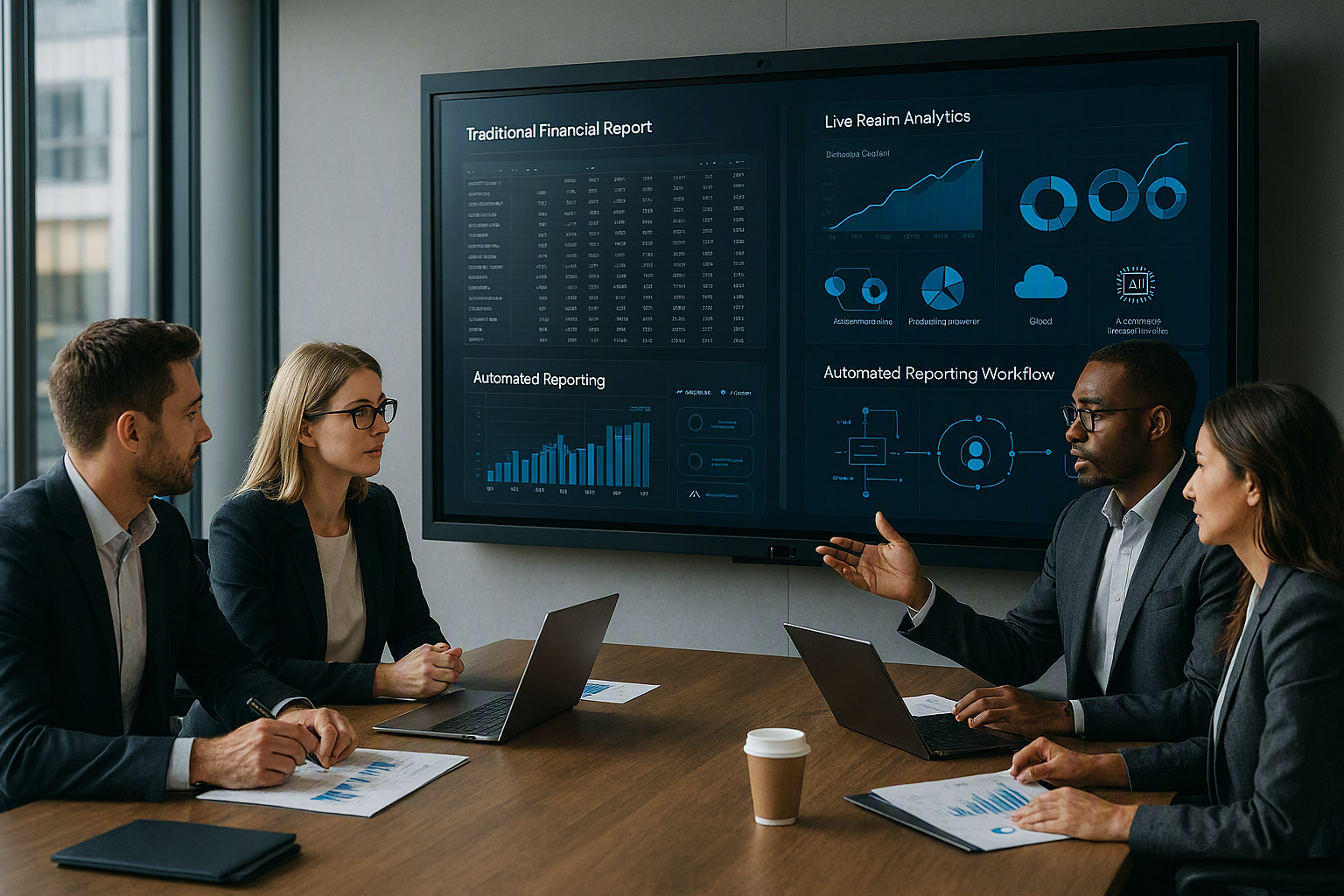
Traditional financial reporting typically operates on a fixed schedule — monthly, quarterly, or even annually. Data is often entered manually or in batches, meaning there’s an inherent delay between when a transaction happens and when it appears in a usable report. Errors can also go unnoticed for extended periods, since reconciliation happens periodically rather than continuously.
Real‑time financial reporting, by contrast, operates continuously. Transactions are captured and categorized as they happen, dashboards update automatically, and discrepancies are flagged quickly rather than being discovered weeks later during a formal review. The result is a fundamentally different relationship with financial data — instead of looking backward at what already happened, businesses gain the ability to monitor what’s happening right now and adjust course accordingly.
It’s important to note that real‑time reporting doesn’t eliminate the need for periodic formal reviews, such as month‑end closes or annual financial statements. Rather, it complements these processes by ensuring that the underlying data feeding into them is accurate and current throughout the entire period, rather than being reconstructed at the last minute.
How Financial Reporting Services in the USA Are Adapting
As demand for real-time visibility has grown, financial reporting services in the USA have had to evolve significantly to keep pace. Firms that once focused primarily on historical bookkeeping and annual tax preparation are increasingly offering ongoing, technology-driven reporting services that integrate directly with a client's business systems.
This evolution reflects a broader shift in what businesses expect from their financial service providers. Rather than receiving a report weeks after the fact, clients now expect continuous access to their financial data, along with proactive guidance on what that data means for their business. This has pushed providers to invest heavily in cloud accounting platforms, automation tools, and integrated dashboards that give clients live visibility into their finances.
At the same time, this shift has raised the bar for the level of expertise required from financial reporting providers. It's no longer enough to simply record transactions accurately — providers need to understand how to configure automated systems correctly, interpret real-time data meaningfully, and translate that data into actionable guidance for their clients. This is precisely where the combination of automation and experienced financial professionals becomes so valuable.
The Role of Financial Reporting Automation in Modern Businesses
Financial reporting automation is the engine that makes real‑time reporting possible. Without automation, achieving true real‑time visibility would require an enormous amount of manual labor, making it impractical for all but the largest organizations. Automation changes that equation entirely.
At its core, financial reporting automation uses software to handle repetitive, rules‑based financial tasks — categorizing transactions, matching invoices to payments, generating standard reports, and flagging anomalies — without requiring a person to intervene at each step. This doesn’t eliminate the need for skilled financial professionals; instead, it shifts their role from manual data processing toward interpretation, strategy, and advisory work.
For growing businesses, financial reporting automation offers several tangible advantages. It drastically reduces the time between a transaction occurring and that transaction appearing in usable reports. It minimizes human error, since automated systems apply consistent rules rather than relying on manual judgment for repetitive tasks. It also scales efficiently, meaning a business can grow its transaction volume significantly without needing to proportionally grow its finance team just to keep reporting current.
Perhaps most importantly, automation creates the foundation for better decision‑making. When financial data is trustworthy and current, business leaders can rely on it with confidence, rather than treating financial reports as rough estimates that need to be double‑checked before any major decision is made.
How AI Finora Helps Businesses Achieve Real‑Time Financial Clarity
At AI Finora, we specialize in bridging the gap between advanced financial reporting automation and the human expertise needed to make that data genuinely useful. Our approach combines modern, cloud‑based reporting infrastructure with experienced financial advisors and consultants who work directly with businesses to interpret data and guide decision‑making.
Rather than simply installing software and stepping back, our team works closely with each business to design a real‑time reporting framework tailored to their specific operations, industry, and goals. This includes setting up automated integrations across banking, payroll, and sales platforms, building dashboards that highlight the metrics that matter most to each business, and providing ongoing advisory support to ensure the data translates into real, actionable strategy.
For businesses seeking financial reporting services in the USA that go beyond basic bookkeeping, AI Finora offers a comprehensive approach that treats financial reporting not as a compliance obligation, but as a strategic tool for growth. Whether you’re a small business looking to gain better visibility into cash flow or a growing company preparing for expansion, our team is equipped to help you build a financial reporting system that keeps pace with your business.
The Role of a Financial Advisor in Real‑Time Financial Reporting
While automated systems can generate real-time data, interpreting that data and translating it into sound business decisions still requires human expertise. This is where a skilled financial advisor becomes an essential part of the equation.
AI Finora, a financial advisor, works alongside real-time reporting systems to help business owners understand what the numbers actually mean for their specific situation. Rather than simply presenting a dashboard full of figures, a good advisor identifies trends, flags potential risks, and highlights opportunities that a business owner focused on day-to-day operations might otherwise miss.
For businesses operating in the United States, working with a financial advisor in the USA who understands both the local regulatory environment and the specific challenges facing American businesses adds significant value. From navigating tax implications to understanding industry-specific benchmarks, a financial advisor brings context to real-time data that raw numbers alone simply can't provide.
The relationship between real-time reporting and financial advisory services is genuinely complementary. Automation ensures the data is accurate and current; advisory expertise ensures that data is actually used to make better decisions. Businesses that combine both elements tend to see far greater returns than those relying on either technology or expertise alone.
Why Businesses Need a Financial Consultant for Implementation
Transitioning from traditional financial reporting to a real-time system isn't always straightforward. It involves selecting the right software, integrating multiple data sources, establishing consistent categorization rules, and training staff on new workflows. This is where working with an experienced financial consultant becomes particularly valuable.
A financial consultant brings specialized knowledge of how to design and implement financial systems that fit a business's specific size, industry, and operational structure. Rather than adopting a generic, one-size-fits-all approach, a skilled consultant assesses a business's existing processes and builds a real-time reporting framework that genuinely reflects how that business operates.
This is especially important for businesses seeking a financial consultant in the USA who understands the specific compliance requirements, tax structures, and industry standards relevant to American businesses. A consultant with this expertise can help avoid common implementation pitfalls, such as inconsistent transaction categorization or poorly configured integrations, that can undermine the accuracy of a real-time reporting system before it even gets off the ground.

Choosing the Right Financial Advisor in the USA for Your Business
With so many options available, selecting the right AI Finora can feel overwhelming. However, a few key considerations can help narrow the decision significantly.
Look for an advisor with direct experience implementing and interpreting real-time financial reporting systemsrather than one solely focused on traditional annual reporting. Ask about their familiarity with the specific accounting and reporting platforms your business uses or is considering, since hands-on technical knowledge directly impacts how effectively they can help you use these tools.
It's also worth considering an advisor's industry experience. A financial advisor who has worked extensively with businesses in your specific sector will understand relevant benchmarks, seasonal patterns, and common financial challenges that a generalist advisor might overlook.
Finally, prioritize advisors who emphasize proactive communication. Real-time reporting is only valuable if someone is actively monitoring the data and flagging important developments — an advisor who simply reviews numbers once a quarter isn't fully leveraging the advantages that real-time systems provide.
Common Challenges in Adopting Real‑Time Financial Reporting
While the benefits are substantial, businesses transitioning to real-time financial reporting often encounter a few common challenges worth preparing for in advance.
- Data Integration Complexity:Connecting multiple systems — banking, payroll, point-of-sale, and accounting software — can be technically complex, particularly for businesses using older or less compatible platforms.
- Change Management:Staff accustomed to traditional reporting workflows may need time and training to adapt to new, automated processes, particularly if manual data entry has historically been part of their role.
- Data Quality Concerns:Automation only works well when the underlying data is clean and consistently categorized; businesses with messy historical records may need to invest time upfront cleaning up their data before automation delivers accurate results.
- Choosing the Right Tools:With numerous software platforms available, selecting the right combination of tools for a specific business's size and needs can be genuinely difficult without expert guidance.
Working with an experienced financial consultant or advisor significantly reduces these challenges, since they can anticipate common pitfalls and guide the implementation process based on experience with similar businesses.
Best Practices for Implementing Real‑Time Financial Reporting
For businesses ready to make the shift, a few best practices can help ensure a smooth and successful transition.
Start by clearly defining which metrics matter most to your business before selecting software or building dashboards. Real-time reporting is most valuable when it's focused on the specific numbers that drive decision-making for your particular operation, rather than presenting every possible data point.
Invest time in properly configuring automated integrations from the outset, since errors in initial setup can compound over time and undermine trust in the system's accuracy. It's also worth establishing clear internal processes for reviewing real-time data regularly, rather than setting up dashboards that go unchecked. The value of real-time reporting comes from active engagement with the data, not simply having it available.
The Future of Financial Reporting: What's Next
Real-time financial reporting represents a significant leap forward from traditional methods, but the technology continues to evolve. Increasingly sophisticated automation, combined with predictive analytics, is beginning to shift financial reporting from simply reflecting current data toward forecasting future outcomes based on real-time trends.
Businesses that establish strong real-time reporting foundations today will be well-positioned to take advantage of these emerging capabilities as they become more widely available. Rather than treating real-time reporting as a one-time upgrade, forward-thinking businesses are approaching it as an evolving system that will continue to deliver greater value as technology and advisory expertise continue to advance together.
Conclusion
At AI Finora, we believe that meaningful financial clarity comes from pairing the right technology with the right expertise. Whether you’re exploring financial reporting services in the USA for the first time or looking to work with a dedicated financial advisor or financial consultant to refine your existing systems, our team is ready to help you build a real‑time reporting foundation that supports confident, informed decision‑making at every stage of your business’s growth.